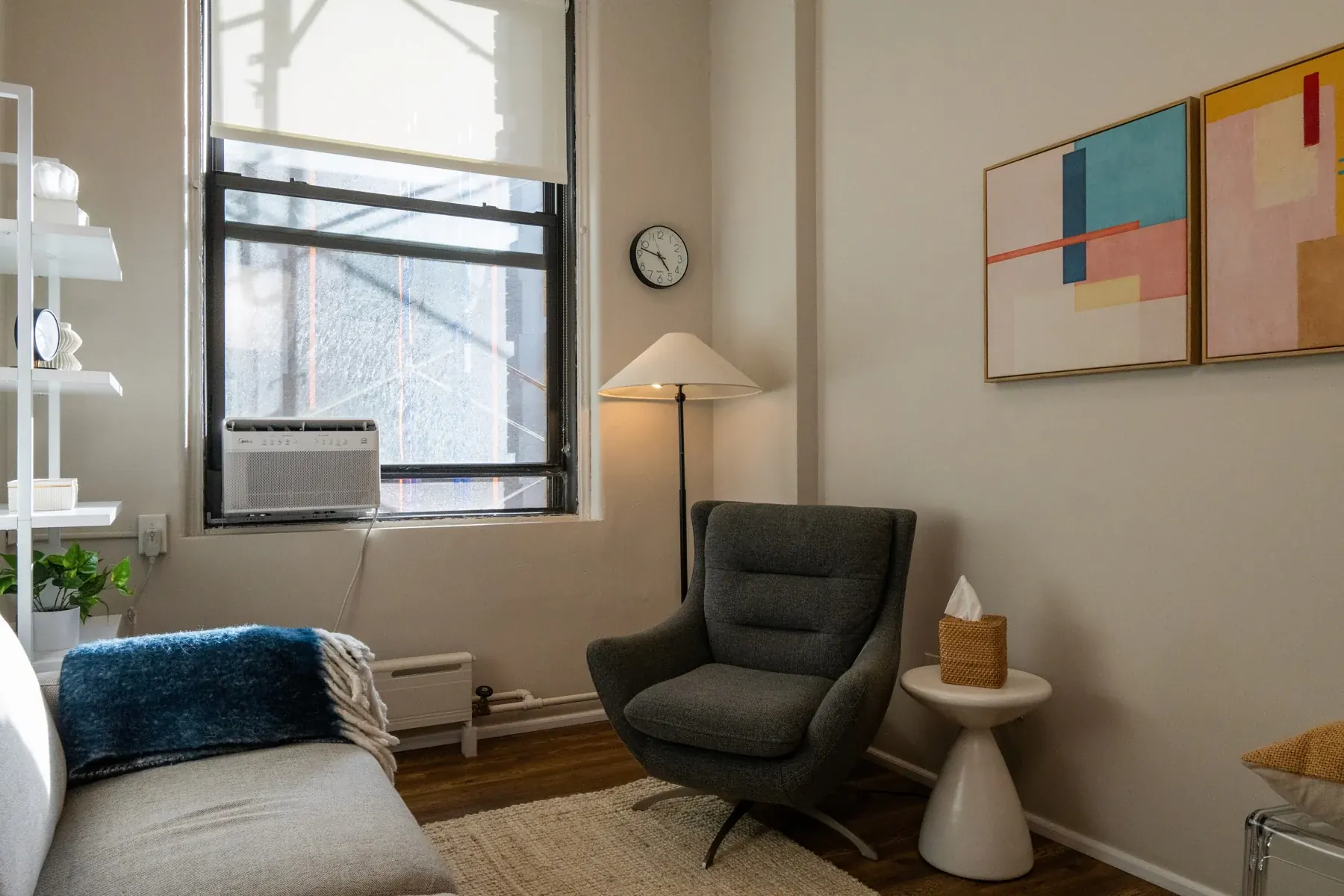
In my psychotherapy practice, I help patients from around New York get at the root of their anxiety—while also learning simple strategies that can help manage anxiety symptoms.
So, whether your anxiety comes from a Midtown boardroom, a social gathering in Chelsea, or a commute back and forth to Brooklyn, the Bronx, or Queens, here are five tools that, combined with professional support, can help you live better with anxiety.
1. Breathing is non-negotiable for managing anxiety.
We are often told to "just breathe," but without understanding the science, this can feel like a platitude.
Deep breathing is the fastest way to signal to your brain that danger has passed. Biologically, diaphragmatic breathing (repeated and deep) melts the state of high physiological arousal. It forces the parasympathetic nervous system—the "rest and digest" system—to take back control.
I recommend four specific breathing techniques for my clients:
The 4-7-8 Method: Developed by Physician Dr. Andrew Weil as a "natural tranquilizer," you inhale for 4 seconds, hold for 7, and exhale through pursed lips for 8. It is the long, slow exhale that is the secret sauce for calming the heart rate.
Hand on Heart and Belly: This provides somatic comfort. It mimics being held and helps us focus on deep breathing from our diaphragms, rather than shallow breathing from our chests.
Box Breathing: Inhale for four seconds, hold for four seconds, exhale for four seconds, and then hold for four seconds before repeating. This works well for those needing a more structured or rhythmic way to ground themselves.
Butterfly Tapping: This works to help soothe an oncoming panic attack. Put one wrist on top of the other (facing you). Interlock your thumbs with hands open and facing to either side (like wings). With interlocked thumbs over your heart and the palms of your hands on your chest, gently and rhythmically alternate taps on your chest. Do this for several minutes while breathing deeply and imagining your heartbeat slowing to the rhythm of your taps. This decreases hyperarousal and can interrupt the escalation of panic by consciously interrupting your focus as well as providing a soothing, rhythmic sensation to the body.

2. Do the thing, and you show yourself that you have power over anxiety.
Avoidance is a clever trap. When we feel anxious, our natural instinct may be to avoid the source of the discomfort.
Think of avoidance as prolonged suffering disguised as safety.
When you avoid the thing you fear, you inadvertently teach your brain that the perceived danger was real. This actually gives your fear more power.
[H2] The mind can only focus on one thought at a time.
While our minds can scan several thoughts with dizzying speed, in reality, our minds can only hold one thought at any single moment.
Focusing on a calming mantra or a single calming task helps interrupt the anxiety loop.
3. An “anxious” decision is often a bad decision.
No one likes uncertainty. In fact, some of us literally cannot tolerate it.
If this describes you, pay attention to the stories your mind tends to create in the absence of information. When we are anxious, those stories often reveal our greatest insecurities and fears.
This is the worst position from which to decide anything. By disengaging from the story and replacing action with curiosity, we rob anxiety of its distorting power and gradually regain our agency.
4. When it comes to anxiety, feelings are often the last things to change.
I know this sounds counter-intuitive, but bear with me.
People generally want to “feel like” doing something BEFORE they do it. The reality is that many of the feelings people actually want only occur AFTER an action is taken.
Calm feelings usually don’t precede a feared action, but they often follow it. When you can’t talk yourself out of a feeling, you can act your way into a new way of being. We use our sessions as your lab to create new associations that lead to new ways of being in the world.
5. Support to put strategies to manage anxiety into practice.
In my clinical practice, I’ve seen firsthand how important a supportive psychotherapist can be in helping actually put these anxiety management strategies into practice. Without that partner, a list of strategies is just that: a list.
If you’re in New York and looking for help managing your anxiety, you don’t have to do this alone. Together, we’ll get you from a state of "spiraling" to a state of grounded certainty. Send me a message and let’s talk about how I can help you.

Vincent Handon, MPS/LP
Licensed Psychoanalyst in New York, trained at The National Institute for the Psychotherapies.